Research prototype · synthetic data only

Off your baseline?

Baseline compares a person with their own history, not with an average or a diagnosis. We are starting with a view that shows a therapist how reported experiences change between sessions.

How it works
01

Answer

Short, established questionnaires, a few chosen words and an optional daily check-in. Any question can be skipped.

02

Over time

Every answer on its real date, next to the person’s own history. Gaps and anything not comparable stay visible.

03

Discuss

What was reported since the last consultation, with counts and sources. No score and no verdict: the therapist decides what to talk about.

Fictional data · illustrative only day 0 · 0 check-ins
daily answer · energy consultation personal history band no check-in since last consultation
since the last consultation · descriptivemedians with n · no score, no verdict
What exists today

Two prototypes.
Fictional people only.

Both run on synthetic data. Neither has been used with real patients or participants, and neither is a medical device.

Therapist view · Perspective Current focus
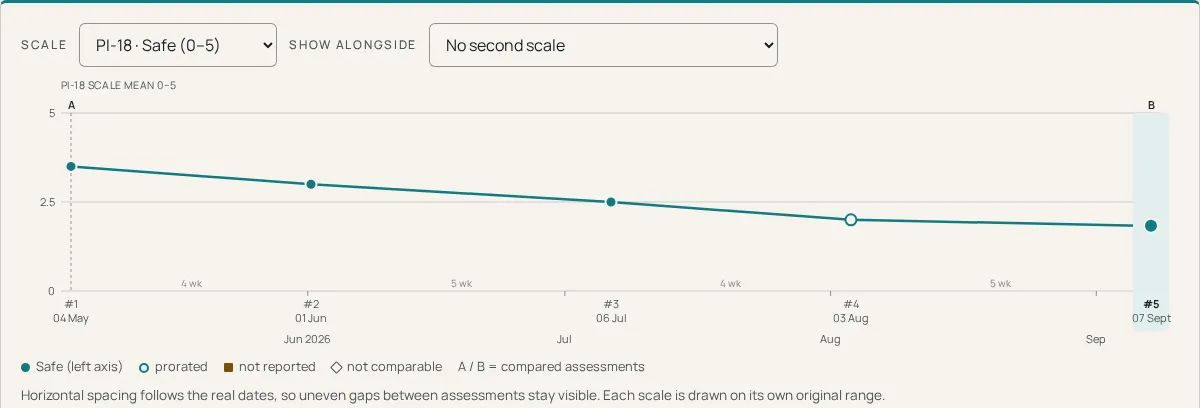
Line chart of one questionnaire scale across five assessments of a fictional patient from May to September, spaced by calendar date, with a reference and a compared assessment marked A and B.
One scale over five assessments, spaced by calendar date. Synthetic data.
  • Two established questionnaires, the Primals Inventory (PI-18) and the Mini-IPIP, each scored separately on its own range. No combined score, norms or cut-offs.
  • An experimental daily check-in: three questions on 0–10 sliders, each kept as its own series and never combined.
  • The patient sees no scores. The therapist sees answers as given, with dates, scoring provenance and missing data, in a summary, a timeline, charts and session preparation.
  • Rule-based prompts are labelled unvalidated and link to the exact answers that triggered them.

Personal baseline engine Early skeleton
  • Turns daily inputs (a short check-in, daily health summaries, calendar counts) into one state per day.
  • Learns a rolling 28-day baseline per feature and flags a shift of two or more standard deviations that lasts seven days, only after 14 days of history.
  • The model decides whether something changed. A template, or later a language model, only explains it, and the person marks the explanation accurate or incorrect.
  • Runs end to end on synthetic histories. Real text encoding, persistent storage, encryption and deployment are not built.

These settings are working assumptions of the prototype, not validated values.

Within-person

Your normal isn’t
someone else’s normal.

We look at change within one person, not differences between people. A stable person with an unusual baseline should not be flagged again and again.

Population-levelone threshold
Within-personone history per person
within-person comparison validated instruments, scored separately no norms or cut-offs missing data shown, not hidden refuse when the data are too thin
Why describe first

A change only means something against a person’s own history.

Every view says what it rests on

dates number of answers days without answers what is not comparable
Company

The  international  team.

David Klingbeil, CEO
David Klingbeil
Founder / CEO
Gregor Tikautz, Behavioral Science
Gregor Tikautz
Founder / Behavioral Science
Lena Bryll, COO
Lena Bryll
Founder / COO
Software built by

See how a reported world shifts.

Therapists, researchers and future participants: leave your email and we will write when there is something to try or a study to join.

Research-stage prototypes on synthetic data. Not a medical device, not a diagnostic service and not a replacement for professional mental-health care. Not an emergency service. No study with participants has started. Your email is submitted through Netlify Forms; see Privacy & compliance.